
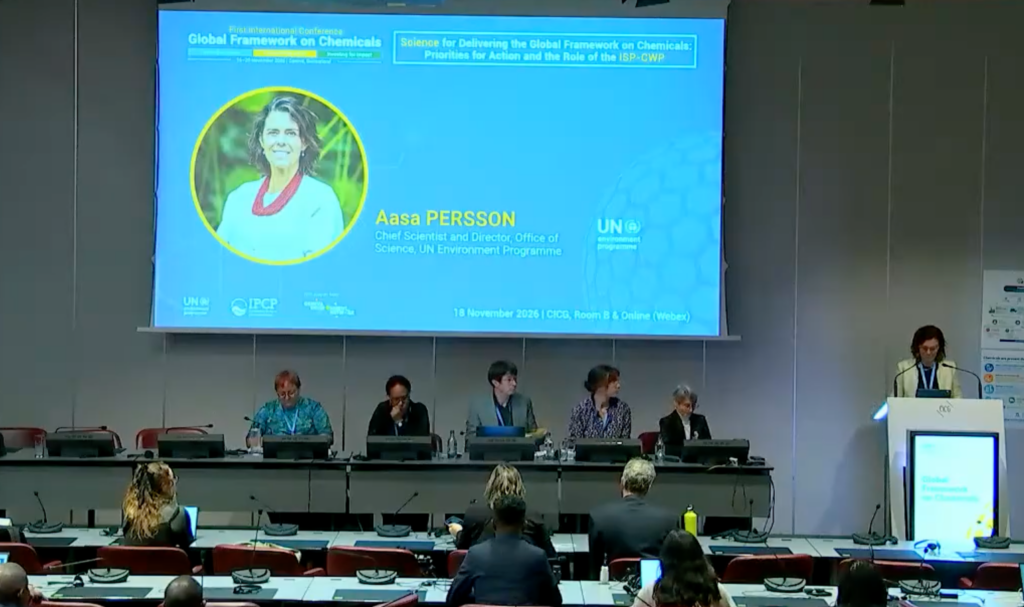
We were delighted to see the strong interest in our event, Science for Delivering the Global Framework on Chemicals: Priorities for Action, co-organized by the International Panel on Chemical Pollution (IPCP) and UNEP, and moderated by Miriam Diamond. The discussion brought together valuable perspectives on the critical role of science in achieving the ambitions of the Global Framework on Chemicals (GFC).
A few highlights from the contributions:
🔹 Åsa Person, newly appointed Chief Scientist at UNEP (a warm welcome!), highlighted the importance of science as a foundation for informed decision-making.
🔹 Osvaldo Álvarez-Pérez, Chair of the new Intergovernmental Science-Policy Panel on Chemicals, Waste and Pollution (ISP-CWP), presented the ambition of the panel and the opportunities it presents.
🔹 Marlene Ågerstrand highlighted how independent scientific evidence on CFCs, DDT, and PCBs helped lay the foundations for international agreements such as the Montreal Protocol and the Stockholm Convention. Independent science continues to play a vital role in informing regional and national chemicals regulation, including on PFAS and endocrine-disrupting chemicals. Looking ahead, the new science-policy Panel offers an important opportunity to strengthen this contribution by supporting the development of scientifically robust indicators, interpreting global trends in chemicals management, advising on comparable monitoring approaches, identifying global monitoring gaps, and informing the prioritisation and identification of issues of global concern.
🔹 Martin Scheinger addressed a fundamental challenge: if the science is already available, why are we still not acting? What are the barriers preventing scientific evidence from translating into meaningful policy and action? He mentioned several bottlenecks on the way from scientific findings to political or regulatory action, such as lack of access to the scientific information; formats of the scientific information that are highly technical and difficult to access for non-scientists; other, more pressing problems to be addressed by policy makers and regulators; resistance by societal actors with vested interests. In particular the first two can be – and should be – addressed by the ISP-CWP and the GFC. They are fora where scientific findings can be translated and reshaped and then relayed to users in policy making.
🔹 Andreia Costa Santos highlighted four key priorities for accelerating the transition to green and sustainable chemistry: internalising costs and ensuring financial accountability, including redirecting fossil fuel subsidies towards green technologies; stimulating demand and scaling up alternatives through public procurement and R&D; ensuring regulatory predictability through clear phase-outs, harmonised indicators and supply-chain transparency; and, above all, protecting human capital as the foundation for a successful transition.
🔹 Kateřina Šebková, drawing on her extensive experience at the science-policy interface, emphasised the important role researchers have in actively translating policy-relevant scientific knowledge to policy-makers and regulators.
🔹Miriam Diamond concluded that we need robust evidence to guide effective, no-regret solutions that avoid burden shifting and unintended consequences. We need to keep advocating for science-informed decisions and stronger connections between science and policy to improve the protection of human health and the environment. The Global Framework on Chemicals provides an important opportunity to strengthen these connections, and the new science-policy panel has an important role to play. But scientific knowledge alone will not deliver change. We also need political commitment, effective governance and the willingness to act on the evidence.
A big thank you to UNEP, all speakers, and everyone who joined the discussion and contributed to making this such an engaging event!