
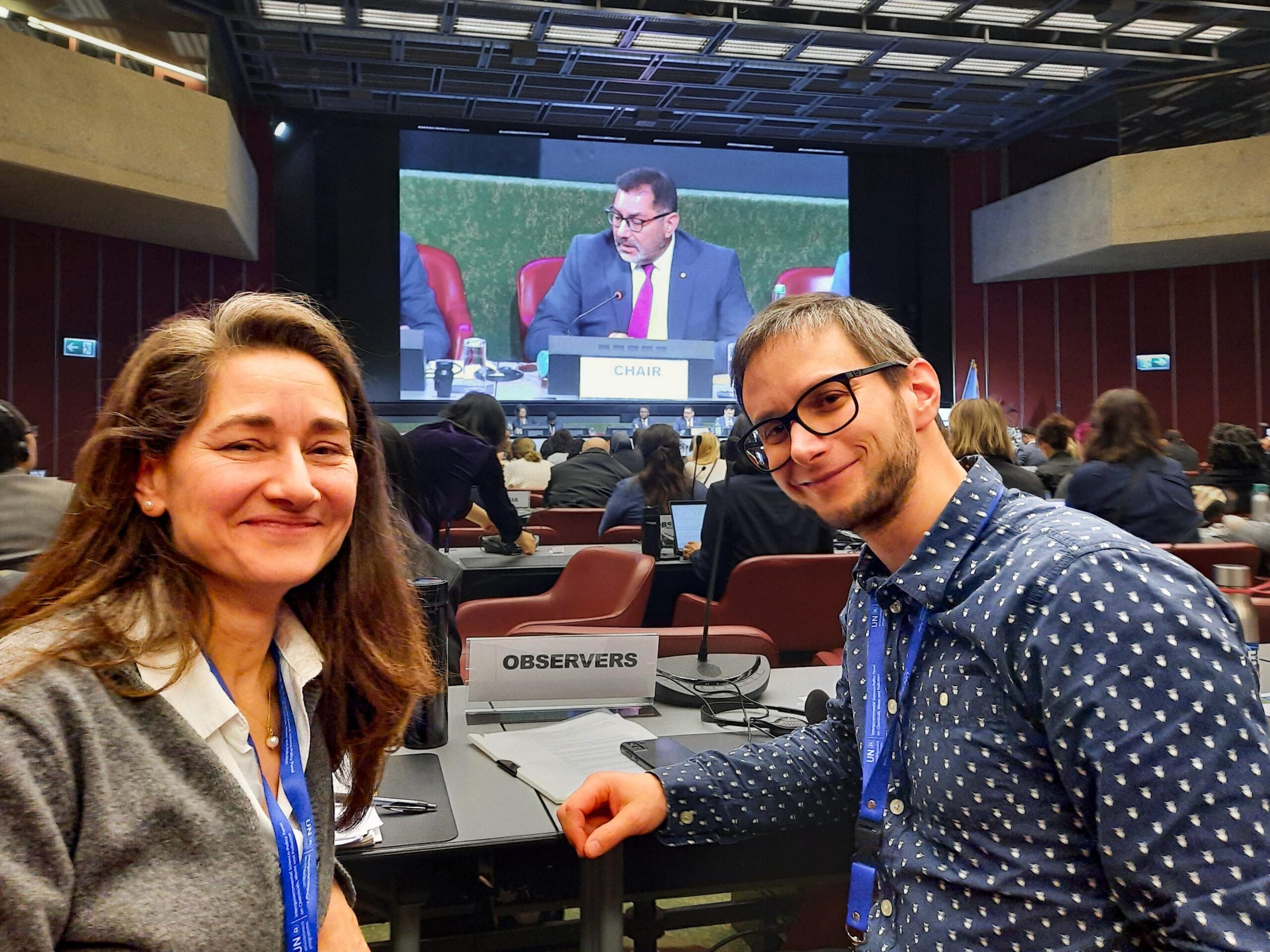
Ipek Imamoglu & Gabriel Sigmund
The first session of the Plenary of the Intergovernmental Science-Policy Panel on Chemicals, Waste and Pollution (ISP-CWP P1) concluded in Geneva, Switzerland on 6 February 2026. The IPCP delegation included Gabriel Sigmund and Ipek Imamoglu who also provided daily meeting summaries. Policy briefs prepared by the IPCP as inputs to the process are available here. Other IPCP board members in attendance included Noriyuki Suzuki as a member of the delegation from Japan and Miriam Diamond as the Chemicals & Waste member of the Scientific and Technical Advisory Panel of the Global Environment Facility.
Day 1 – The Gridlock of the Cardassians
Full of enthusiasm and hope, the morning opened with a meeting of the “stakeholder” group ably co-chaired by by a Children and Youth representative and Gabriel Sigmund from IPCP. The group finalized a joint statement to be delivered at the opening Plenary. Through negotiation, all stakeholders quickly reached collegial consensus, in stark contrast to what we were about to witness in the Plenary. The statement includes support for the Panel to take precautionary approaches, which was an item of some debate considering the diverse stakeholders present that included IPCP, Children and Youth, the Women’s group and industry colleagues. At the core, the joint statement from the stakeholder group voiced collective support for a swift and efficient advancement of the Panel, recognizing that processes take time, but emphasizing that the operationalization of the Panel is urgent. The statement went on to say that the Stakeholder Group “offers breadth of expertise, knowledge and experiences the Panel needs to meet its deliverables. In doing so, we will always base ourselves on knowledge, evidence, precautionary approaches, inter-generational equity, respect for the rights of Indigenous Peoples and gender responsiveness.”
With this very positive and hopeful outcome from the familiar windowless stakeholder meeting room we moved to the main plenary, which opened with Swiss horn music and inspiring speeches by Inger Andersen, the Executive Director of UNEP and Under Secretary General of the United Nations, as well as Katrin Schneeberger, the Director of the Swiss Federal Office for the Environment. With Ms. Andersen acting as Chair, the first order of business was electing the Chair of the Plenary. And the politics and delay tactics started! For the purposes of this text, we shall consider those who appeared to decelerate the process as part of the “Cardassian Union”. They excelled in the art of delay, with members of the United Federation of Planets and their friends and allies doing their best to keep the positive momentum going. Cardassian strategies included creative demands such as the complete listing of all members of the United Federation of Planets, and concerns that the Chair could become a dictator. How difficult it was to constrain our emotions on that one!
After a “5 min break” which ended up being two hours of intense negotiations, the Plenary finally elected the first Chair of the Panel: Osvaldo Alvarez Pérez using the rule set out for this purpose by the UN Environment Assembly. A very first success and a step in the right direction!
The next and main order of business for the meeting was deciding on the Rules of Procedure that will govern the Panel’s work. Some of those rules must align with the Foundational Document (which contains some brackets which means that the bracketed text doesn’t legally exist). Due to the lack of agreed upon Rules of Procedure, the election of the rest of the Bureau members was postponed. This is important, because the Bureau will be key in guiding the Panel. Also, the procedural debates just to elect the Chair far exceeded the planned time for the plenary and thus made our wonderfully phrased joint stakeholder statement from the morning obsolete. Still, the agreement among the stakeholders stands and remains a motivating element in this exhausting environment. And: we do have a Chair!
As IPCP delegates we had a wonderful and inspiring lunch-meeting with the delegation of Japan, that gave us much needed rejuvenised hope on the eventual work that the Panel will advance the frontier of international environmental multilateralism. In this meeting, Japan asked for our thoughts on the horizon scanning deliverables of the Panel. We shared ideas on how language barriers, publication bias and poor data coverage and quality can be tackled with differing horizon scanning approaches by exploring and considering knowledge and lived experiences from a diversity of backgrounds. These considerations should inform the formation of the expert groups conducting horizon scanning. We also raised the importance of adopting a hazard-based approach, especially for horizon scanning, which is prospective in nature. In contrast, impact- and risk- based assessments are inadequate for these types of activities of the Panel as they are only possible retrospectively.
Following this inspiring conversation and exchange, we headed back to the plenary room where the rest of the day and night was filled with draining deliberations on the Rules of Procedure in the contact group (delegates left the Contact Group around 23:00). Therein the Rules of Procedure were painstakingly dissected sentence-by-sentence and need to be finalized before the Bureau can be elected. This process will continue tomorrow, likely over the whole day.
Late in the dark rainy night we found our way back into our hotel rooms to get some sleep and recharge our batteries for the next day. We are confident that we will arise refreshed with our tricorders in our hands, ready to analyze whatever may come…
Policy briefs and other materials prepared by the IPCP as inputs to the process are available at: https://www.ipcp.ch/policy-briefs/
https://www.ipcp.ch/publications/
Longer daily reports prepared by the International Institute for Sustainable Development, Earth Negotiations Bulletin are available at: https://enb.iisd.org/isp-cwp-p1-intergovernmental-science-policy-panel-chemicals-waste-pollution
Official UNEP website: https://www.unep.org/isp-cwp/plenary/session-1